
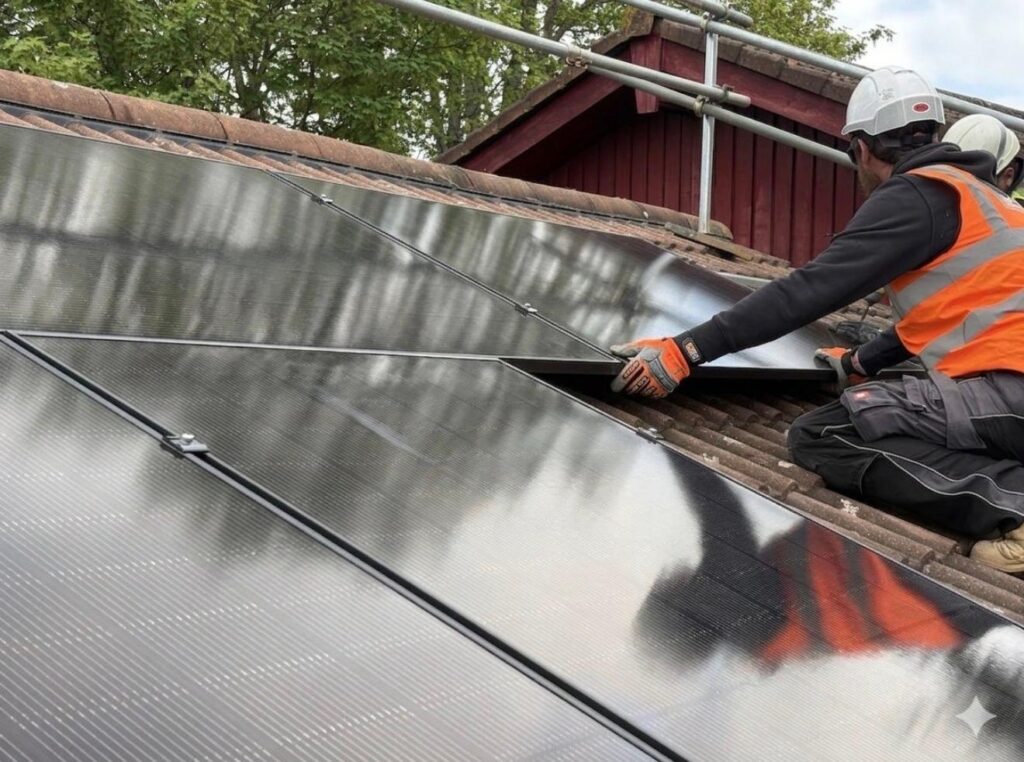
With energy costs remaining an important consideration for UK households, more homeowners are looking at ways to reduce the amount of electricity they need to buy from the grid. One of the most established options is generating electricity directly from your own roof.
But one of the first questions homeowners understandably ask is: how much money can solar actually save?
There isn’t a single figure that applies to every property. The savings available depend on the size and performance of the system, the property’s location, roof orientation, electricity prices and, crucially, how much of the electricity generated is actually used within the home.
For the right property, Solar Panels can reduce reliance on grid electricity and provide savings over many years. Understanding how those savings are generated is the best way to decide whether solar is appropriate for your home.
How Do Solar Panels Reduce Your Electricity Bill?
A solar installation generates electricity from daylight.
During periods when the system is producing electricity, your home can use that power instead of purchasing the equivalent electricity from your energy supplier.
Imagine your property is using 2kW of electricity at a particular moment and the solar system is generating 1.5kW. A significant proportion of the electricity being consumed by the property can then be supplied by the solar installation rather than coming from the grid.
That is where the direct saving occurs.
The more of your own solar-generated electricity you can use, the less electricity you generally need to purchase.
However, generation varies throughout the day and year. Solar output is typically greater during longer, brighter summer days and lower during the winter months.
How Much Could a Typical Household Save?
The exact financial saving needs to be calculated for the individual property rather than relying on a headline figure.
Two apparently similar houses can achieve different results because the households use electricity differently.
A household where people are regularly at home during daylight hours may naturally consume more solar-generated electricity as it is being produced.
Someone who is away from home throughout the day may export a larger proportion of their generation to the grid unless they have other ways of making use of it.
Your electricity tariff is another important factor. If grid electricity becomes more expensive, every unit of solar electricity you use directly can potentially become more valuable because it replaces a more expensive imported unit.
For this reason, financial projections should be based on realistic information about the property and household rather than guaranteed savings.
System Size Makes a Difference
The capacity of a solar system has a major influence on how much electricity it can generate.
A larger installation can generally produce more electricity than a smaller installation, but simply installing as many panels as physically possible isn’t always the right approach.
The system should be designed around factors including available roof space, orientation, shading and the property’s electricity requirements.
A professional assessment can establish how many panels can reasonably be installed and estimate the amount of electricity the proposed system could generate.
That estimate can then be compared against household electricity consumption to provide a clearer idea of potential savings.
Roof Direction, Angle and Shading
The position of your roof influences solar generation.
Orientation, pitch and shading should all be considered when designing a Solar PV system.
Trees, neighbouring buildings, chimneys and other obstructions can create shade at different points during the day. Depending on the property, this may affect the output of some or all of the panels.
A roof doesn’t necessarily need to be perfectly south-facing for solar to be worthwhile. Other orientations can still generate useful amounts of electricity, although the expected output and generation pattern may differ.
This is why property-specific design matters.
Rather than assuming every installation will generate the same amount of electricity, expected performance should be calculated using the characteristics of the individual building.
Using More of the Electricity You Generate
Generating electricity is only part of the equation.
How you use it can make a significant difference to the financial benefit.
If your panels are generating electricity while very little power is being consumed within the property, surplus electricity may be exported to the grid.
Homeowners can therefore increase their self-consumption by shifting some electricity use into daylight hours where practical.
For example, appliances such as washing machines and dishwashers could potentially be used during periods of solar generation rather than later in the evening.
Smart controls and timers can make this easier.
The objective isn’t necessarily to change your entire routine around the weather. It’s simply to make better use of electricity that is already being generated on your roof.
Can Solar Batteries Increase Your Savings?
One of the limitations of a solar-only installation is that generation and household demand don’t always occur at the same time.
Solar production can be strong during the middle of the day, while many households experience higher electricity demand during the evening.
Solar Batteries can help bridge that gap.
Rather than immediately exporting all surplus solar electricity, a compatible battery system can store some of that energy for use later.
For example, electricity generated during the afternoon could potentially be stored and then used during the evening when the panels are generating less or nothing at all.
This can increase the proportion of solar electricity consumed within the property and further reduce reliance on imported electricity.
Whether battery storage makes financial sense depends on the household’s generation, consumption patterns, electricity tariff and the cost and specification of the battery system.
What Happens to Electricity You Don’t Use?
Surplus solar electricity doesn’t necessarily have to go to waste.
Depending on your arrangements with an energy supplier, electricity exported to the grid may qualify for an export payment.
This means a solar system can potentially provide value in two ways: reducing the amount of electricity purchased from the grid and receiving payment for eligible surplus electricity exported.
Export rates and tariff conditions vary between suppliers, so homeowners should check the current terms available to them.
In many cases, using solar electricity directly within the property can still be particularly valuable because it replaces electricity that would otherwise have been purchased at the household’s import rate.
Solar Panels and Other Energy-Efficiency Measures
Solar doesn’t have to operate as an isolated home improvement.
Increasingly, homeowners are looking at the energy performance of their entire property.
Insulation can reduce the amount of heat a building loses. Solar can generate electricity at the property. Battery storage can help shift when that electricity is used.
The relationship becomes particularly interesting in homes using electrically powered heating technologies such as an Air Source Heat Pump.
A heat pump and solar system perform different functions, and solar generation will not necessarily match heating demand, particularly during winter. However, considering generation, heating, insulation and energy consumption together can help homeowners develop a more complete approach to reducing reliance on purchased energy.
The right combination will depend on the individual property.
What Is the Payback Period for Solar?
Homeowners often want to know how many years it will take for their energy savings to equal the original cost of installation.
This is usually referred to as the payback period.
There is no universal answer.
The initial installation cost, annual electricity generation, percentage of electricity used directly, export payments, future energy prices and maintenance requirements can all influence the calculation.
Adding battery storage also changes both the initial investment and how electricity is used.
Rather than choosing solar based purely on the shortest advertised payback period, it is more useful to obtain a realistic projection based on your own property.
Solar installations are designed as long-term improvements, so potential performance should be considered across many years rather than focusing only on the first year of savings.
Do Solar Panels Still Work During Winter?
Yes, although electricity generation varies considerably by season.
Solar panels generate electricity from light rather than requiring hot weather. They can therefore still produce electricity on cool or cloudy days.
However, shorter daylight hours and generally weaker solar conditions mean UK systems typically generate considerably less electricity during winter than during summer.
This seasonal variation should already be taken into account when annual generation is estimated professionally.
Homeowners shouldn’t expect a solar installation to make them completely independent from the electricity grid throughout the year.
Instead, it should be viewed as a way of generating a proportion of the electricity the property requires and reducing the amount that needs to be purchased.
How Can You Get the Best Financial Return?
Getting the most from solar starts with installing an appropriately designed system.
Roof space, orientation, shading and household consumption should all be considered before deciding on the size and specification.
After installation, homeowners can also pay attention to when electricity is being generated and consumed.
Using appliances during daylight hours, considering battery storage where appropriate and monitoring system performance can all help increase the value obtained from the electricity being produced.
It is also worth reviewing available electricity and export tariffs periodically, as the most appropriate arrangement may change over the lifetime of the system.
Are Solar Panels Worth Considering?
For many suitable UK properties, solar can provide a practical way to reduce the amount of electricity purchased from the grid.
Exactly how much money you could save depends on your home, system and electricity usage, which is why generic savings figures should always be treated cautiously.
The strongest starting point is a property-specific assessment that considers available roof space, likely generation and your existing electricity consumption.
At Render Right, we work across renewable energy and energy-efficiency improvements, helping property owners understand which measures are appropriate for their buildings.
A well-designed solar installation isn’t simply about putting panels on a roof. By considering generation, household demand, storage and other energy-efficiency measures together, homeowners can make better use of the electricity they generate and potentially reduce their energy costs for many years to come.


